

Beyond Motion Sensors: AI's Role in Home Security
For years, home security meant a panel, a few window sensors, and a whole lot of false alarms. Traditional systems react after a breach, alerting you when a door is opened or a window is broken. They're easily tripped by pets, weather, or even a swaying tree branch. This reactive approach often leaves you feeling frustrated and, frankly, less secure.
Now, things are changing. Artificial intelligence is moving home security beyond simple detection to intelligent threat assessment. We’re seeing systems that can distinguish between a delivery driver and a potential intruder, or recognize unusual behavior patterns that suggest something isn’t right. It’s a shift from responding to events to anticipating them.
The core of this change is the ability of AI to analyze data – video feeds, sensor readings, even sound – and make informed decisions. This is more than just filtering out false positives, though that's a huge benefit. It's about understanding context and prioritizing genuine threats. As we look to 2026, expect this trend to accelerate, with AI becoming the standard, not the exception, in home security.
CNET recently highlighted how AI filters are helping to reduce unnecessary alerts, making home security systems actually useful. It’s a simple idea, but a profoundly important one. The goal isn’t to eliminate all alerts, but to ensure the ones you receive demand your attention.
The Top 5 AI Home Security Systems (2026)
While predicting home security in 2026 is difficult, several companies are developing AI-powered systems. Here are five systems expected to lead the field, based on current development and announced features.
1. SimpliSafe Prime AI (estimated $280 + $25/month monitoring): SimpliSafe is investing heavily in AI video analytics. Their 2026 Prime AI package is expected to feature enhanced object recognition, identifying people, vehicles, packages, and specific animals. Integration with smart locks and lighting is planned, along with a more responsive mobile app. A potential drawback is reliance on professional monitoring for full AI functionality.
2. ADT Smart Home with Neural Guard (estimated $600 + $45/month monitoring): ADT is using its infrastructure with a new AI layer called Neural Guard. This system focuses on behavioral analysis, learning household routines to identify anomalies. It will integrate with more smart home devices than previous ADT systems, but the initial cost and monthly fees are substantial.
3. Ring Protect Pro AI (estimated $200 + $20/month monitoring): Ring, a leader in video doorbells, will expand AI features to all Ring cameras with their 2026 Pro AI package. Expect improved facial recognition (with privacy controls), more accurate person detection, and proactive alerts based on learned patterns. Data privacy concerns remain a consideration with Ring.
4. Cove Security Plus AI (estimated $180 + $20/month monitoring): Cove aims to offer a more affordable AI-powered option. Their system focuses on rapid response times, using AI to quickly verify alarms and dispatch emergency services. While its AI features are less extensive than SimpliSafe or ADT, it provides a solid baseline for AI-enhanced security at a competitive price.
5. Brinks Home AI Vision (estimated $500 + $35/month monitoring): Brinks Home prioritizes AI video analysis with its AI Vision package. Features include advanced object detection, facial recognition, and custom activity zones. Brinks’ strength is its professional monitoring and smart home automation integration, but it's a more expensive option. Brinks Home offers guidance on understanding these costs on its website.
These are estimates; pricing and features may change as systems evolve. The best system depends on your needs, budget, and comfort with data privacy.
Featured Products

Integrated bright floodlight · AI-powered person, animal, and vehicle detection · 24/7 live streaming and two-way audio
Its AI capabilities provide intelligent threat detection and enhanced visibility for outdoor security.

Built-in eero Wi-Fi 6 router · 14-piece comprehensive security kit · Backup battery and cellular connection for the base station
This system integrates robust home security with advanced networking capabilities, offering a smart and connected home experience.

Smart motion detection · HD video recording · Seamless integration with SimpliSafe system
It provides intelligent indoor surveillance and alerts, enhancing the overall security of your home.

Door and window sensors with phone app alerts · DIY wireless setup · Works with Alexa
This affordable system offers smart, app-based alerts for entry points, providing peace of mind for smaller spaces.

Expandable 16-piece kit · Mobile app control and optional professional monitoring · Compatible with Alexa and Google Assistant
This system provides a comprehensive and customizable security solution with smart home integration and professional monitoring options.
As an Amazon Associate I earn from qualifying purchases. Prices may vary.
AI Features Explained: What Can These Systems Do?
These systems' power comes from specific AI features. Let's break down key technologies and what they achieve.
Object Recognition: This is the foundation of most AI security systems, identifying what it sees: person, vehicle, animal, package, etc. Accuracy varies, but modern systems distinguish well between people and objects. Expect fewer false positives than with traditional motion detection.
Facial Recognition: This feature identifies specific individuals, showing who is on your property. However, it raises privacy concerns. Most systems let you create a "whitelist" of recognized faces to alert you only for unknown individuals. Accuracy is improving, but lighting and angles can affect performance.
Behavior Analysis: This is where AI becomes truly intelligent. The system learns your household’s patterns—when people typically come and go, what activities are normal—and flags anything out of the ordinary, such as loitering, unusual movement, or unexpected activity at odd hours. Its effectiveness relies on a sufficient learning period.
Sound Detection: AI analyzes audio to identify specific sounds like glass breaking, shouting, or a smoke alarm, adding security for areas without cameras. CNET notes filtering irrelevant sounds is key to avoiding alert fatigue. A good system ignores your dog barking but alerts you to a window shattering.
AI isn’t perfect. Accuracy rates vary by system, camera quality, and environment. Expect occasional false alarms and the need to fine-tune settings.
Privacy Concerns and AI Security
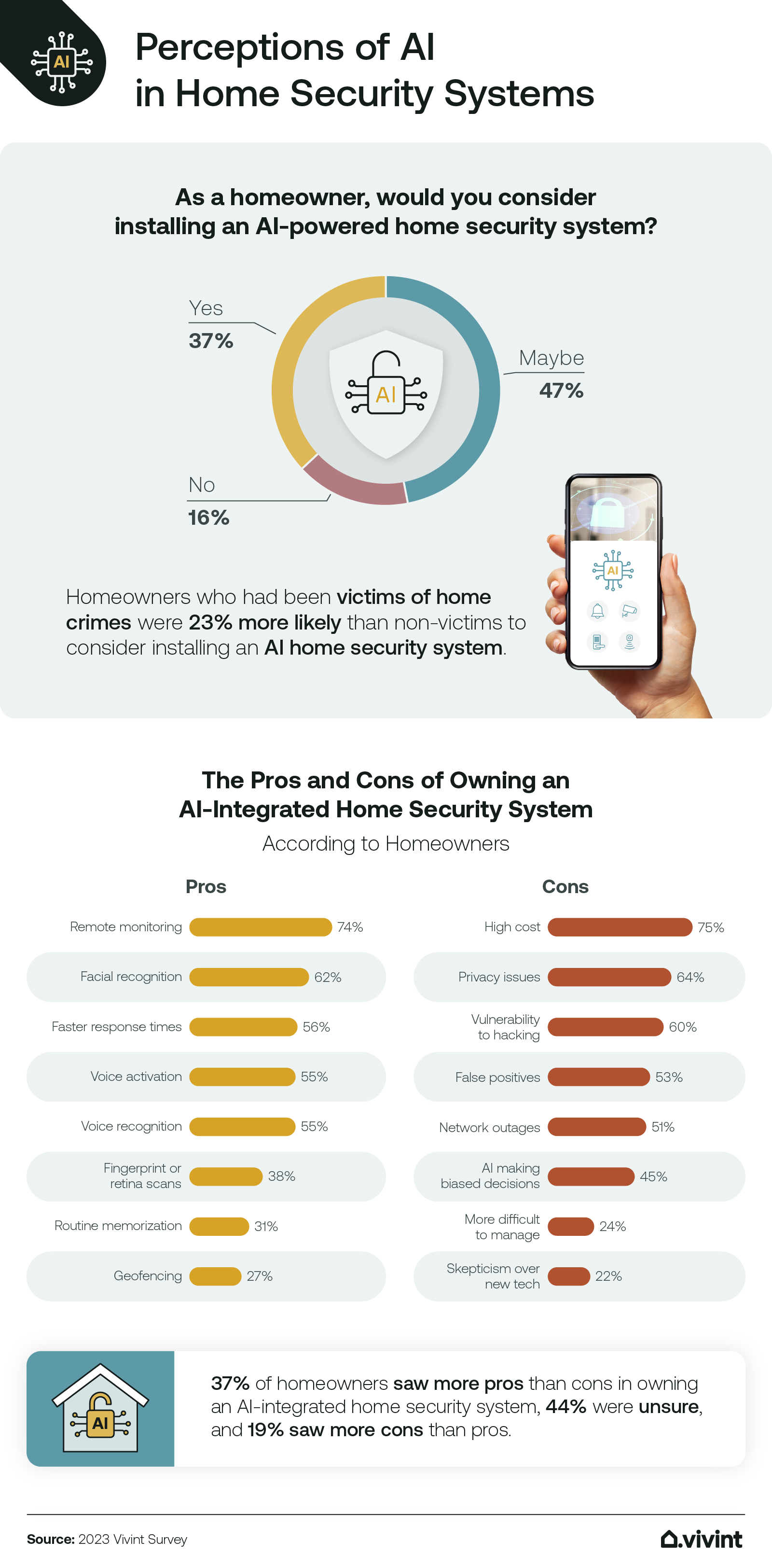
The increased data collection inherent in AI-powered security systems raises legitimate privacy concerns. These systems are constantly recording and analyzing video and audio, and that data needs to be stored and protected.
Facial recognition is a particularly sensitive issue. How is that data stored? Is it encrypted? Is it shared with third parties? Reputable companies will offer clear privacy policies and allow you to control your data. Look for options to disable facial recognition altogether if you’re uncomfortable with it.
Beyond data collection, there’s the risk of hacking. A compromised security system could give attackers access to your video feeds and personal information. This is why strong passwords and two-factor authentication are essential. Regularly update your system’s firmware to patch security vulnerabilities.
Consider what data the system collects and how it's used. Some systems offer end-to-end encryption, meaning only you can access your data. Others may store data in the cloud, which could be subject to government requests or data breaches. Choosing a system with robust security measures and a transparent privacy policy is paramount.
- Use strong, unique passwords.
- Enable two-factor authentication.
- Regularly update system firmware.
- Review the company's privacy policy.
- Consider end-to-end encryption options.
Installation and Costs: A Realistic Look
AI-powered home security systems vary in cost based on equipment, monitoring plan, and installation. Hardware costs range from $200 to $600+, with monthly monitoring fees typically between $20 and $60.
DIY installation is possible for many systems but requires technical skill. You need to be comfortable connecting devices to Wi-Fi, mounting cameras, and configuring settings. Professional installation is available but adds cost.
Brinks Home offers resources for understanding security system costs. Factor in cloud storage for video recordings; many systems offer limited free storage, requiring a subscription for longer periods.
Beware of hidden fees or long-term contracts. Some companies require multi-year contracts, activation fees, or early termination fees. Read the fine print carefully.
AI-Powered Home Security System Comparison - 2026
| System Name | Installation Difficulty | Monthly Monitoring Cost | Contract Length | Cloud Storage Options |
|---|---|---|---|---|
| SimpliSafe | Easy | Medium | None | Standard |
| Abode | Moderate | Medium | None | Premium |
| Vivint | Difficult | High | 3 Years | Premium |
| ADT | Moderate | High | 3 Years | Standard |
| Cove | Easy | Medium | None | Limited |
Illustrative comparison based on the article research brief. Verify current pricing, limits, and product details in the official docs before relying on it.
AI and Smart Home Integration
One of the biggest benefits of AI-powered security systems is their ability to integrate with other smart home devices. This allows you to create automated routines that enhance both security and convenience.
For example, you could set up a routine that automatically turns on your lights and locks your doors when the security system is armed. Or, you could have the system send you a notification if a door is left unlocked after a certain time. Integration with smart locks, thermostats, and lighting systems allows for a truly connected and responsive home.
Compatibility with major smart home platforms like Amazon Alexa, Google Assistant, and Apple HomeKit is also important. This allows you to control your security system using voice commands and integrate it with other smart home devices from different manufacturers.
A fully integrated smart home security system provides a level of control and automation that was simply not possible with traditional systems. It's about creating a proactive security environment that adapts to your lifestyle and protects your home.
Future Trends: What's Next for AI Security?
The future of AI-powered home security is bright, with several exciting advancements on the horizon. We can expect to see more sophisticated AI algorithms that can predict potential threats before they occur. This could involve analyzing data from multiple sources – social media, news reports, weather patterns – to identify areas at risk.
Edge computing will play an increasingly important role. By processing data locally on the security device, rather than sending it to the cloud, edge computing can improve response times and enhance privacy. This means faster alerts and less reliance on a stable internet connection.
Personalized security systems that adapt to individual user behavior are also likely to become more common. The system will learn your routines and preferences, and adjust its security settings accordingly. This will create a more seamless and effective security experience.
However, these advancements also come with potential risks. The increasing sophistication of AI could make it more difficult to detect and prevent cyberattacks. It’s crucial that security companies prioritize data privacy and security as they develop these new technologies.



No comments yet. Be the first to share your thoughts!