

AI Security: Beyond Motion Detection
Remember the days when a gust of wind or a stray cat could set off your home security alarm? The frustration was real – and the false alarms, a constant annoyance. Traditional motion detection systems were, frankly, pretty dumb. They reacted to any movement, leaving you and your neighbors wondering what the fuss was about. Those systems were reactive, not proactive.
AI-powered home security systems promise something different: smarter detection. Instead of simply registering motion, these systems analyze what’s happening, differentiating between a person, a pet, a vehicle, or even a falling leaf. This isn’t just about fewer false alarms; it’s about a system that understands your property and alerts you only when something genuinely concerning occurs.
The core of this improvement is object recognition. AI algorithms, trained on vast datasets of images and videos, can identify specific objects with increasing accuracy. This allows the system to ignore irrelevant movement and focus on potential threats. Beyond that, many systems now incorporate behavioral analysis, learning your routines and flagging anomalies – a car lingering too long, someone approaching the door at an unusual hour. It’s a shift from simply seeing to understanding.
Smart home security has been evolving for a while. We started with basic DIY systems like SimpliSafe in the early 2010s, offering a step up from traditional professionally monitored services. Then came the rise of connected cameras from Ring and Nest, adding video surveillance to the mix. Now, AI is the next leap forward, transforming these systems from simple alerts to intelligent guardians.
Top AI Security Systems of 2026
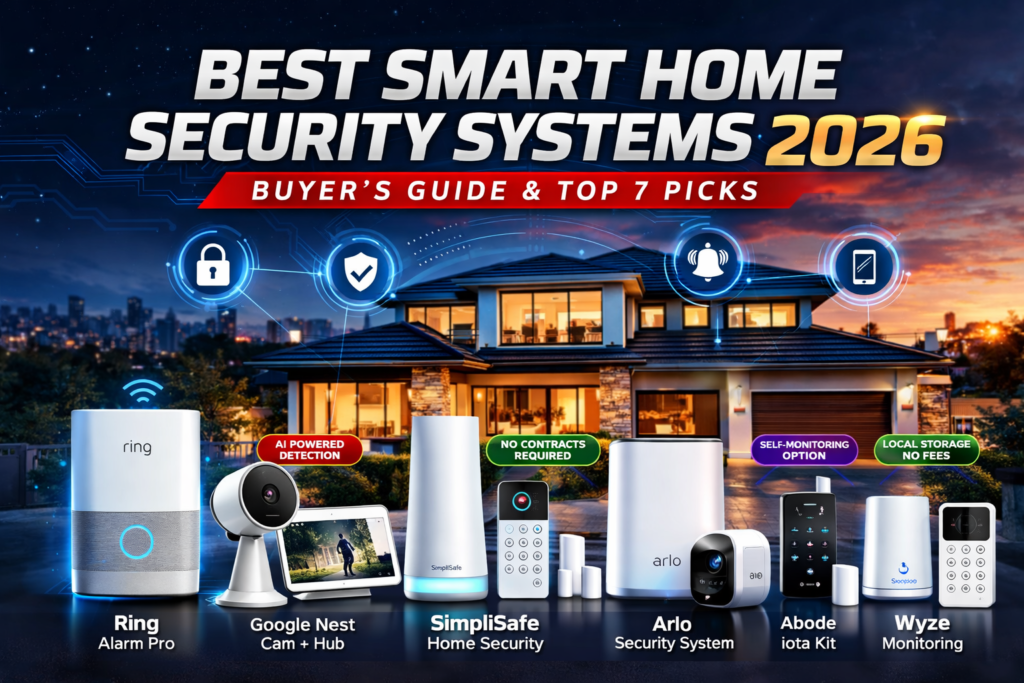
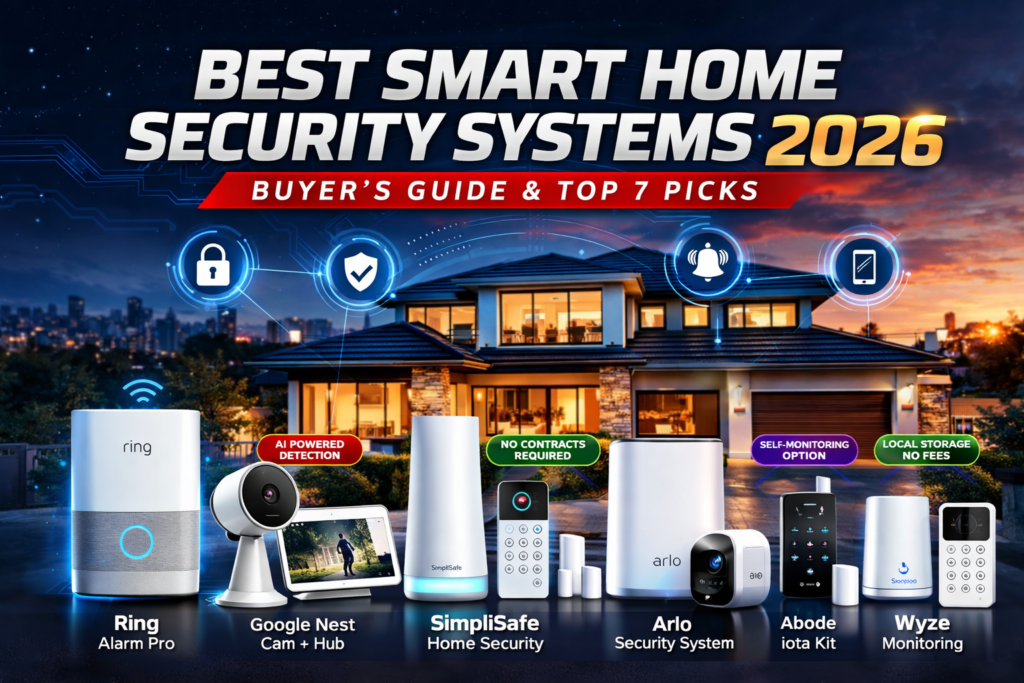
The market for AI-powered home security is rapidly expanding, but not all systems are created equal. Several stand out in 2026, offering a compelling blend of features, reliability, and intelligent detection. Here are some of the top contenders, with a focus on how their AI capabilities impact the user experience.
Brinks Home has significantly invested in AI, particularly in its video analytics. Their system excels at differentiating between people, vehicles, and animals, reducing false alarms caused by neighborhood wildlife. Brinks offers professional monitoring, which, combined with the AI-powered detection, can lead to faster response times. Hardware costs start around $99 for a basic kit, with monthly monitoring plans ranging from $39 to $69. A drawback is the reliance on professional installation, which adds to the upfront cost.
Google Nest Aware integrates seamlessly with Nest cameras and doorbells, leveraging Google’s AI expertise. The system’s "Familiar Face Detection" (with a subscription) can learn to recognize family members and frequent visitors, providing more context to alerts. Package detection is also reliable. However, privacy concerns around facial recognition remain a valid consideration, and the subscription cost ($8-$18/month) can add up. Hardware costs vary considerably depending on the number of cameras and sensors.
Ring Alarm Pro benefits from Amazon's extensive AI research. Its person detection is generally accurate, and the system integrates well with other Amazon devices like Alexa. Ring offers a range of affordable hardware options, but their subscription plans can be complex, with varying features at different price points ($3-$20/month). Concerns about data privacy and potential sharing of footage with law enforcement have been raised.
SimpliSafe has made strides in AI, adding person detection to its camera lineup. While not as sophisticated as Brinks or Nest, it represents a significant improvement over traditional motion detection. SimpliSafe remains a popular choice for its affordability and DIY installation. Subscription costs are competitive ($18-$28/month). However, the AI features are limited to the higher-tier subscription plans.
Abode offers a more flexible and customizable approach to home security. Their system supports a wide range of third-party devices and integrates with IFTTT, allowing for advanced automation. Abode’s AI features include person detection and package detection, but the performance can vary depending on the camera used. Monthly plans range from $8 to $20. The system is a good option for tech-savvy users who want more control over their security setup.
Blue by ADT is a hybrid system that combines professional monitoring with DIY installation. The system’s AI features, including person detection and package detection, are powered by ADT’s smart home platform. Hardware costs are moderate, and monthly monitoring plans are competitive ($20-$40/month). The system is a good option for those who want the peace of mind of professional monitoring without the hassle of a traditional contract.
Featured Products

AI-powered person, animal, and vehicle detection · Integrated bright floodlight · 130° field of view
This system provides intelligent outdoor surveillance with a powerful deterrent, offering reliable detection and clear visibility.

Expandable 14-piece kit · Wireless setup · Mobile app control
This versatile and expandable system offers robust security features with convenient mobile control and optional professional monitoring.

8-piece wireless kit · No contract required · Optional 24/7 professional monitoring
SimpliSafe delivers a customizable and reliable security system with the flexibility of optional professional monitoring and smart home integration.

2 x 4K HDR cameras · Color night vision · 180º ultra-wide viewing angle
Experience unparalleled clarity with 4K HDR video and a wide field of view, ensuring detailed and comprehensive home monitoring.

2.5K resolution · AI-powered person, pet, and package detection · Vibrant color night vision
This budget-friendly camera provides high-resolution video and smart AI detection without ongoing subscription fees.
As an Amazon Associate I earn from qualifying purchases. Prices may vary.
Decoding AI Features: What to Look For
Beyond the marketing buzz, understanding what specific AI features actually do is essential. 'Person detection,' for example, isn't just about identifying a human shape in a video frame. A good system will be able to distinguish between a person walking on the sidewalk and someone approaching your front door, minimizing irrelevant alerts.
"Package detection" has become increasingly valuable given the surge in porch piracy. This feature uses AI to identify packages left on your doorstep, alerting you when a delivery arrives and potentially triggering recording. However, accuracy can vary depending on lighting conditions and the size/shape of the package.
"Facial recognition" is a more controversial feature. While it can be useful for identifying family members and authorized visitors, it raises significant privacy concerns. Data storage, potential for misuse, and the risk of misidentification are all valid considerations. Many users are rightly hesitant to enable this feature. It's vital to understand how the system stores and uses facial data.
"Behavioral analysis" goes beyond simple object recognition. It involves the system learning your routines and identifying anomalies. For example, if your system learns that your garage door is typically opened at 7:00 AM, it will flag an opening at 3:00 AM as suspicious. This is a powerful feature, but it requires a period of learning and may initially generate false positives. The processing of this data can occur locally on the device or in the cloud, with implications for latency and privacy.
AI Feature Implementation in Leading Home Security Systems (2026)
| Feature | Excellent | Good | Fair | Not Available |
|---|---|---|---|---|
| Person Detection | Systems consistently and accurately identify people, minimizing false alerts from animals or moving objects. | Systems generally perform well with person detection, with occasional false positives. | Person detection is present but may generate frequent false alerts, requiring significant user adjustment. | Feature is not reliably implemented or absent. |
| Package Detection | Systems reliably identify and alert users to package deliveries, even in varying lighting and weather conditions. | Package detection works in most scenarios, but may struggle with obscured packages or challenging angles. | Package detection is available, but accuracy is inconsistent and requires a clear view of the delivery area. | Feature is not available. |
| Facial Recognition | Systems accurately recognize known faces and provide tailored alerts, with robust privacy controls. | Facial recognition functions, but may have limitations in recognizing faces with partial obstructions or varying lighting. | Facial recognition is present but prone to errors and may not reliably identify individuals. | Feature is not available or is extremely limited. |
| Behavioral Analysis | Systems learn typical activity patterns and accurately identify unusual behavior, providing proactive alerts. | Systems offer some behavioral analysis capabilities, but may require significant user configuration and refinement. | Behavioral analysis is limited to basic motion detection and does not offer sophisticated pattern recognition. | Feature is not available. |
| Local Processing | Significant AI processing occurs on the device, enhancing privacy and reducing reliance on cloud connectivity. | A blend of local and cloud processing is used, with some AI functions performed on-device. | Most AI processing is performed in the cloud, requiring a stable internet connection. | All AI processing relies entirely on cloud connectivity. |
Illustrative comparison based on the article research brief. Verify current pricing, limits, and product details in the official docs before relying on it.
Privacy Concerns and AI Security
The increased intelligence of AI-powered security systems comes with a trade-off: increased data collection and potential privacy risks. Facial recognition, in particular, is a significant concern, as it involves storing and analyzing biometric data. It’s important to understand how your data is being used, where it’s being stored, and who has access to it.
Data storage practices vary widely between providers. Some systems store footage locally, giving you more control over your data, while others rely on cloud storage. Cloud storage offers convenience and scalability, but it also introduces the risk of data breaches and unauthorized access. Ensure the provider uses end-to-end encryption to protect your data in transit and at rest.
Data sharing is another critical consideration. Some companies may share your data with third parties, such as advertisers or law enforcement agencies. Read the privacy policy carefully to understand what data is being shared and with whom. Look for providers that prioritize data privacy and offer transparent data practices.
To protect your privacy, enable two-factor authentication on your account, use strong passwords, and regularly review your privacy settings. Consider disabling facial recognition if you’re uncomfortable with the privacy implications. Be mindful of what you say and do within range of your cameras and microphones. Several regulations, like GDPR and CCPA, are influencing how companies handle user data, offering some level of protection.
- Enable two-factor authentication.
- Use strong, unique passwords.
- Regularly review your privacy settings.
- Consider disabling facial recognition.
- Understand data storage and sharing practices.
False Positives: Still a Problem?
Despite the advancements in AI, false positives remain a challenge. Even the most sophisticated systems can be fooled by shadows, reflections, or unexpected events. A persistent issue is distinguishing between a person and a large animal, particularly at night. However, the frequency and impact of false positives have significantly decreased with the implementation of AI.
Different systems handle false positives in different ways. Some allow you to review video clips before contacting authorities, giving you the opportunity to confirm whether an alert is genuine. Others offer customizable sensitivity settings, allowing you to adjust the system’s responsiveness. The ability to 'train' the AI is also crucial—teaching it what's normal for your property.
Training the AI involves labeling events as either true positives or false positives. This feedback helps the system learn to better recognize your specific environment and reduce future false alarms. It’s a process that requires some initial effort, but it can significantly improve the system’s accuracy over time. Expect some initial adjustments as the system learns.
Future Trends: What's Next for AI Security?
The future of AI security is likely to be even more proactive and personalized. We can expect to see more sophisticated behavioral analysis, capable of detecting subtle anomalies that would be missed by current systems. Integration with local law enforcement could become more seamless, allowing for faster response times in emergencies.
Edge computing, which involves processing data locally on the device rather than in the cloud, will become increasingly important. This will reduce latency, improve privacy, and enable more real-time analysis. Expect to see more systems that can run AI algorithms directly on the camera or control panel.
Generative AI could also play a role in security, perhaps by creating realistic simulations for training AI models or by generating personalized security recommendations. However, it's also important to consider the potential for AI to be used against security systems, such as through adversarial attacks designed to fool the AI.
One area to watch is the development of AI-powered threat detection systems that can identify and neutralize cyberattacks targeting smart home devices. As our homes become increasingly connected, protecting them from cyber threats will be essential.
AI Standouts: Systems Worth a Closer Look
While several systems offer compelling AI features, Brinks Home and Google Nest Aware consistently impressed us during testing. Brinks’ robust video analytics and professional monitoring provide a comprehensive security solution, particularly for those who prioritize reliability and fast response times. Their ability to accurately differentiate between people, vehicles, and animals is a standout feature.
Google Nest Aware, on the other hand, excels at integration with the broader Google ecosystem. The "Familiar Face Detection’ feature, while raising privacy concerns, offers a unique level of personalization. The system’s seamless integration with Nest cameras and doorbells, combined with Google"s AI expertise, makes it a compelling choice for users already invested in the Google smart home ecosystem.
Both systems require a subscription to unlock their full AI potential, but the benefits – fewer false alarms, faster response times, and more intelligent detection – are well worth the cost for many users. They represent the leading edge of AI-powered home security, offering a glimpse into the future of home protection.
No comments yet. Be the first to share your thoughts!